Insights / Case study
Case study · Repositioning & Equity Story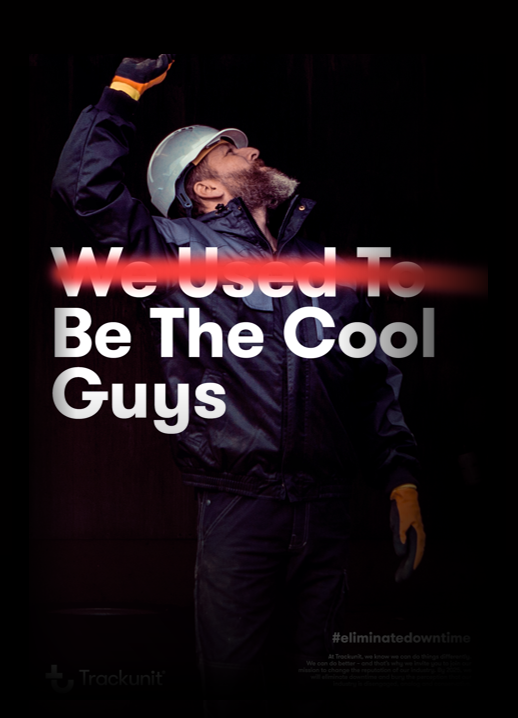
Eliminate Downtime: the brand narrative that turned into a 3bn exit
How a 2017 open letter to the construction industry turned into the equity story behind Goldman Sachs and Gro Capital's exit of Trackunit to Hg Capital.
In 2017, Trackunit did something few vendors in a fragmented, unglamorous industry would risk: it published an open letter to the entire construction industry. Not a product announcement, a public commitment to eliminate downtime, the single largest cost the sector carried, and a problem no individual vendor could credibly claim to solve alone. That letter was the culmination of a large-scale repositioning, and it's where the story that would eventually become Trackunit's equity story actually starts, three years before anyone was thinking about an exit.
The letter had a real diagnosis behind it. In 2018, the European Commission would go on to name construction the least digitalised industry in Europe, a finding Trackunit's own positioning had already anticipated. Over the previous fifty years, productivity in comparable sectors had grown by roughly 1,500%; in construction, it had barely moved. Downtime (idle machinery, broken processes, blown budgets) was the reason why, and no single brand's proprietary system was going to fix an industry-wide problem on its own.
Trackunit had been supplying telematics, the hardware and software tracking construction equipment's location, use, and health, out of Aalborg since 2003. Goldman Sachs and the Danish fund Gro Capital acquired the business in 2015, Goldman taking the majority stake. The repositioning that produced the 2017 open letter happened inside that ownership, well ahead of any exit conversation: reframing Trackunit from a telematics vendor serving one niche into the coalition-builder solving the industry's biggest shared problem. Brand-agnostic by design, so it could connect equipment and data across OEMs rather than compete for any one of their install bases.
My role
At Plateau, I worked as a management consultant to Trackunit from 2016 through 2022, advising on brand narrative, strategy, brand platform, and go-to-market. We also supported the conceptualisation and strategic development of Trackunit Predict, and advised on M&A post-merger integration for the ZTR deal, alongside preparing the business for due diligence ahead of the 2021 exit. In close collaboration with Søren Brogaard, I helped pin down the core narrative and purpose behind eliminating downtime.
What happened next mattered more than the letter itself. Over the following three years, the ambition stopped being a statement and became a track record. Trackunit convened the Eliminate Downtime Committee, gathering the industry's biggest names across Europe and the US around the same problem it had named in 2017. Its data lake, built on twenty years of domain-specific collection, passed 80 million data points, with a stated ambition to grow it sixfold. More than 200,000 users came onto its technology through white-labelled OEM partnerships: “Powered by Trackunit” products that extended its reach far beyond its own brand. By 2020, none of this needed to be invented for a buyer. It had already been proven, in market, for three years.
The financials moved in the same direction, over the same window. EBITDA grew from roughly 90 million DKK in 2019 to more than 100 million in 2020; gross profit nearly doubled, from 60 million to 102 million DKK between 2017 and 2019, the same three years the industry narrative was compounding. That's not a coincidence worth glossing over: the story and the numbers grew together, rather than one being dressed up to flatter the other at the last minute.
The arc, in five moments
2015
Goldman Sachs and Gro Capital acquire Trackunit.
2017
An open letter to the industry launches “Uniting Construction to Eliminate Downtime.”
2017–2020
The Eliminate Downtime Committee, a growing data lake, the launch of the Predict service business, and white-label distribution turn the ambition into a track record.
2020
The repositioning becomes Trackunit's equity story.
2021
Sold to Hg Capital at a valuation Børsen reported above 3bn DKK.
Goldman Sachs and Gro Capital sold their stakes to Hg Capital in 2021, in a deal Børsen reported at more than 3 billion DKK: what the paper called a very high EBITDA multiple, the kind usually reserved for fast-growing software companies, not telematics vendors. For an operating partner, the lesson isn't that Trackunit had a good equity story. It's when that story was written. It wasn't built in the twelve months before a process started; it was published three years earlier, as a public bet the company had to live up to every year after. By the time it needed to carry a premium multiple, nobody had to take Trackunit's word for it.
Figures and quotes: Trackunit's 2017 open letter and equity-story materials; Børsen's coverage of the Hg Capital transaction, 2021.